During my month Europe I had the opportunity to visit three different countries; Italy, France, and England and was able to participate in tastings within each country. I was fascinated by the culture that surrounds food and food enjoyment throughout my stay. There is a movement called the ‘slow food’ movement that is rooted in not just the consumption of food but the end to end journey of preparing the food, the natural ingredients in the food, and the actual eating experience. The point of the movement into retire a focus on taste and enjoyment of the food vs. commoditizing food as fast and available with lots of preservatives. I selected a few of my favorite food experiences that highlight how chef’s are supporting the slow food movement with their unique creations bursting with color, flavor and yet simplicity of natural ingredients. This blog includes favorites from each country I visited, and how these represent the slow food movement at its core.
Berthillon, Paris, France
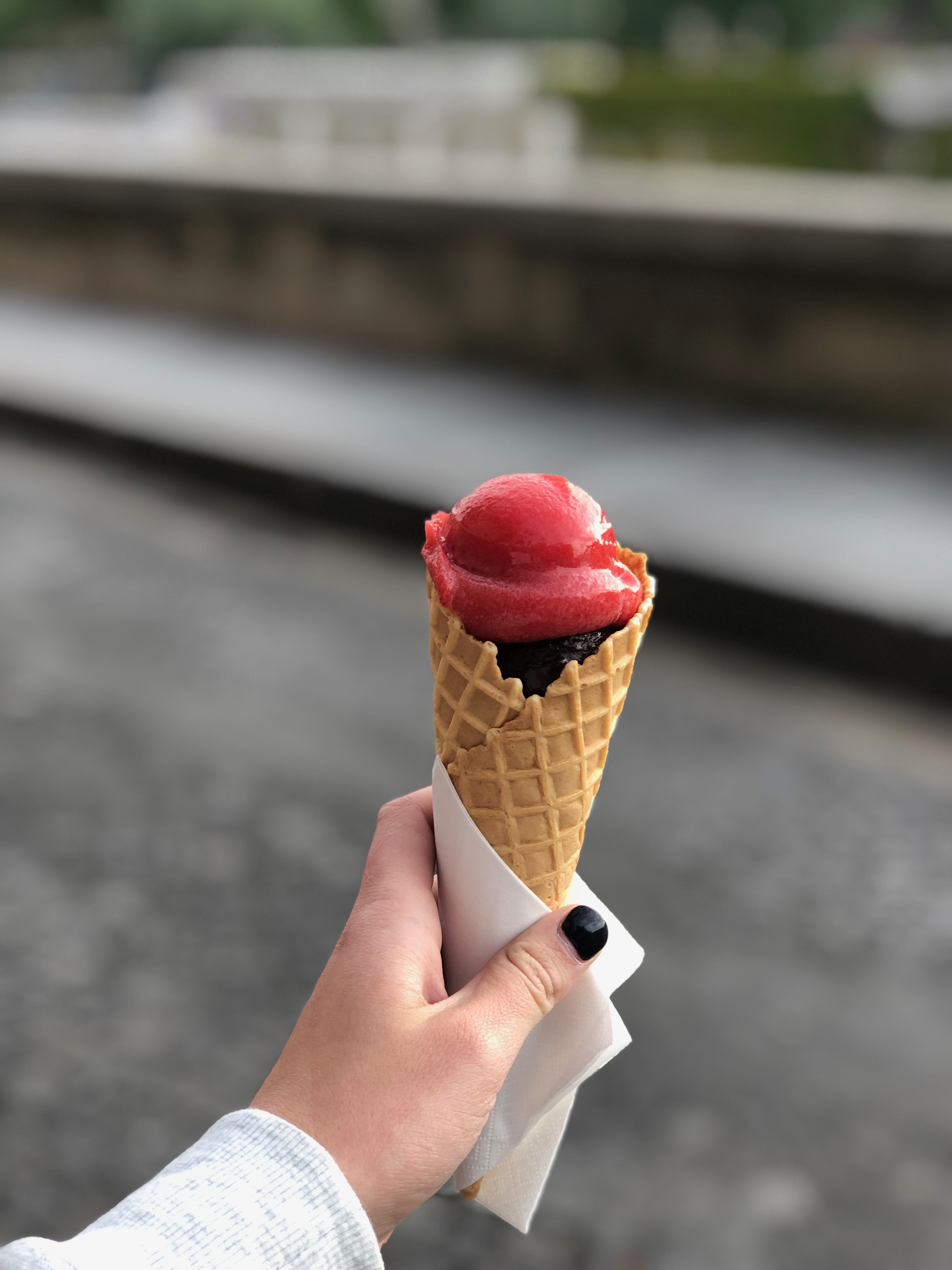
This ice cream restaurant is located 31 Rue St.-Louis-en-l’Ile, 75004 Paris, France. It is in a beautiful historic looking building and the smells and bright colors within the store highlighting the delicacies they sell awake your senses. They serve gelato, ice creams, and sorbet. Their servings are very appropriate and the flavors are bold. Strawberry and Black Chocolate sherbet. It was served simply in a in a cone. Overall I enjoyed the dessert very much. The contrast of the bitter dark chocolate and the light and fruity strawberry was very satisfying. The colors were extremely vibrant and enticing. The fact that this was made from scratch and was enjoyed in its simplest format supporting the concept of the slow food movement was very satisfying. Enjoying the colors, tastes, and aroma and appreciating the work that went into the preparation heightened the experience. I appreciated throughout the trip the clean food that was served minus preservatives and artificial ingredients.
Chemistry Explanation:
Sorbet is created typically with a base of fruit or fruit juice or puree and then it is the sugar in conjunction with the cold determines the final texture. Milk or cream can also be added to sorbet but isn’t a required ingredient. Water can be used to make the flavor more subtle of the base fruit or flavoring. Acidity can be added through citrus to minimize the sweet flavoring or balance the effect of the sugar that is used to create the smooth texture. Gelato is a collaid (information from http://www.icecreamnation.org/science of ice cream). This means it is made through the suspension of air and ice crystals in a sugar solution. Gelato is similar to ice cream in its ingredients and formation however Gelato uses milk vs. heavy cream with a lower fat content. Gelato also contains less air than ice cream resulting in a creamier texture. On the surface Gelato and it’s sister desert ice cream seem simple to make with just three basic ingredients, milk/cream, sugar, ice (and air). However the chemistry is quite complex. As an example typically you would expect fats (like to fats in milk) combined with water (ice) to separate and not form a very smooth consistency. In gelato or ice cream this does not happen due to the process by which it is made. The fat droplets in gelato are formed by the milk used to make it and are comprised of molecules called triglycerides with less than 5% diglycerides and phospholipids. The triglycerides are made up of a glycerol molecule combined with three other molecules which are fatty acids. The temperature at which the fats in gelato melt are also important – if too high a temperature the texture will not be pleasant to ingest. The dairy used in gelato melts at a low temperature resulting in a good consistency. Two other important chemistry factors in ice cream/gelato are emulsifiers these are the molecules that replace some of the milk proteins in the fat droplets, this results in a thinner surface and allows the droplets to combine and trap air as the gelato is formulated. The last important part outside of the freezing itself is the sugar. This you may think is used just for taste, but it is also used to determine the hardness of the output of the gelato, or ice cream. It does this by reducing the freezing point of water and determining the amount of ice that forms in the final product. The softer the ice cream the less ice and therefore less sugar used. This is the very interesting chemistry used to produce the delicious desert we experienced in Italy. Understanding the process makes me appreciate the sweet treat even more.
French Waffle, Paris, France
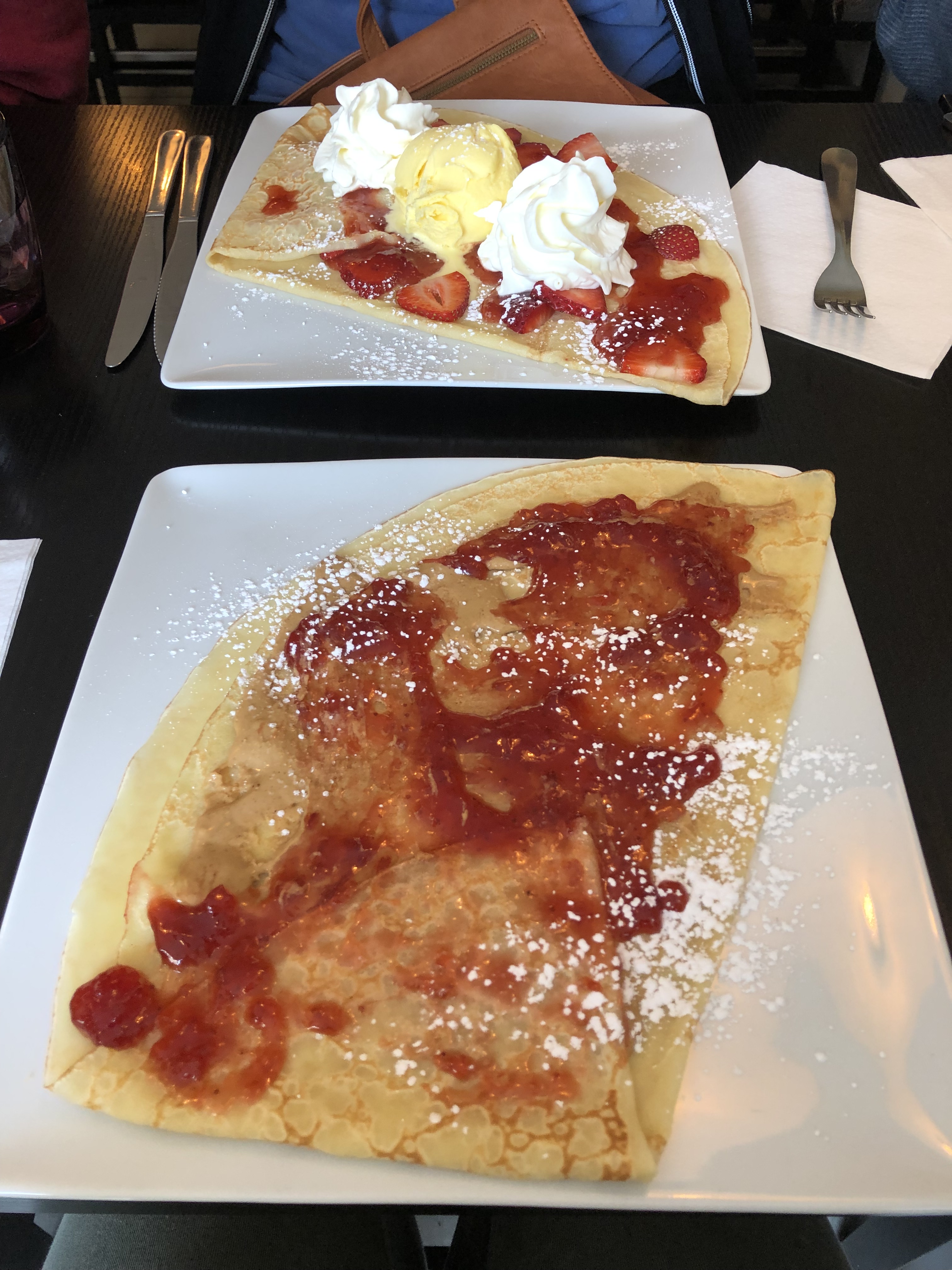
The French Waffle located 197 Rue de Vaugirard, 75015 Paris, France is a small cafe that specializes in crepes or ‘French Waffles’. The restaurant looks from the outside like a traditional French cafe with red awning with matching parlor table and chairs outside. Inside is where the amazing crepes are made. I sampled the peanut butter and Jelly crepe (PB & J) The crepe was perfectly cooked all around and was not too wet. It was golden brown on the outside and soft on the inside. The classic combination of Peanut butter and strawberry Jelly was delicious. The amount of filling was thinly spread across the crepe, so there was flavor in every bite but it did not feel too heavy. The crepe was very warm which allowed its contents to melt and have that right out of the pan experience. The crepe was made with a base of three simple ingredients and the peanut butter and jelly were natural. The food was beautifully presented and full of flavor. The crepes were almost like works of art each one custom made by the chef and each one a unique creation. From the ordering of the crepe to the enjoyment of the finished product each part of the process was part of the satisfaction.
Beigel Bakery
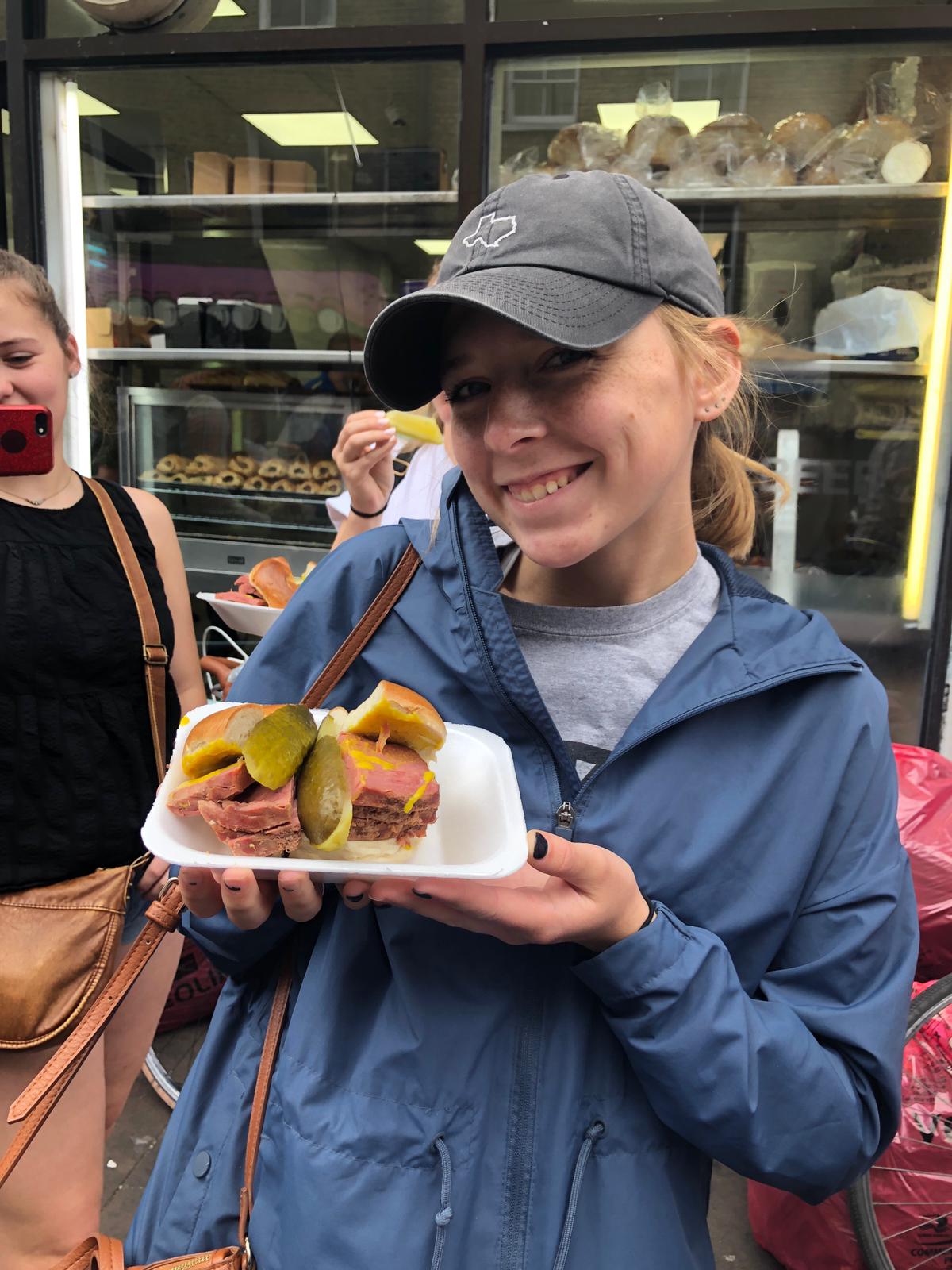
Biegel Bake located 159 Brick Lane, Shoreditch, London, E16SB, UK is a bakery with a polish bagel theme. The plain bagel was boiled and then baked to perfection. Very soft and moist in the center. It was paired with spicy mustard, gherkins pickles, and salted beef. The overall flavor palate was very savory. The simplicity of the process by which the bagels were cooked resulted in an incredible bagel. The small list of ingredients and purity of process while very simple provided complex flavors. The salted beef on the bagel was also very simple but yet strong in flavors and the condiments and gherkin added additional spice and balance to complete the meal.
Chemistry of a Bagel:
Once again a very simple food which we as Americans eat quite frequently is much more complex than one may appreciate. There is one tiny but essential ingredient that packs a big chemistry punch in most of the breads that we eat and that is yeast. This is an ingredient that is actually alive – it has to be alive in order to create the magic that we enjoy with our bagels, breads and other foods. There are multiple types of yeast , the kind used in bagels is baker’s yeast. It is what is used to stretch and raise the dough. this is achieved through the fermentation process during which carbohydrates are converted into organic acids or alcohol. With bagels sugars in the dough are combined with the bakers yeast creating small air bubbles , formed from Carbon Dioxide (CO2) and Ethanol (C2H2O). The se bibles cause the mixed ingredients to lift and result in a sponge like texture. If Baker’s yeast is used it is already processed and ready for baking, however if dry yeast is used it needs to be mixed with hot water this then allows it to interact with the sugars in the flower and releasing the air bubbles. This is what is called fermentation and drives the rising of the dough. The physical parameters are loose bulk density, compressibility, cohesion, angle of internal friction, recoverable work in compression, and residual asymptotic modules after stress relaxation. Yeast has been used for thousands of years to produce breads, other baked goods and alcoholic beverages.
 Cooking With Chemistry